
The DoD Is Cutting Chinese Circuit Boards Out of Defense Hardware. Here's What We're Doing About It.
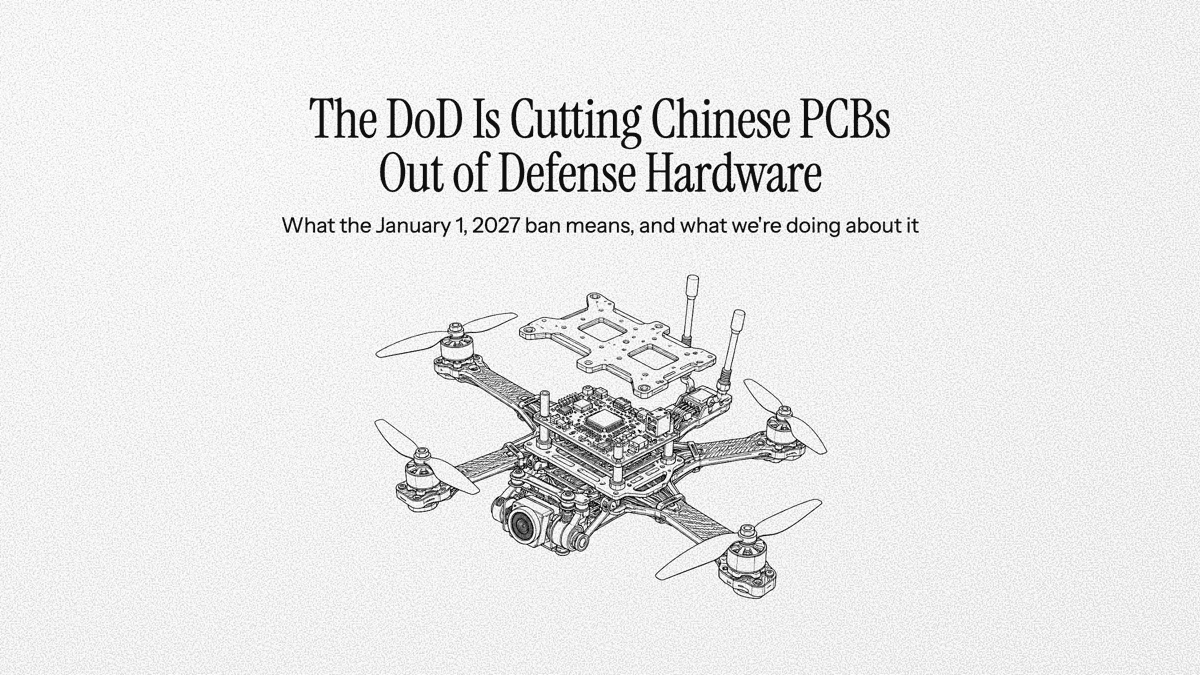
Starting January 1, 2027, the Department of Defense can no longer buy covered printed circuit boards from China, Russia, Iran, or North Korea. The rule is written into federal law at 10 U.S.C. § 4873, and it covers both bare boards and fully assembled ones.
For a lot of hardware teams, that is a big change. If your board ends up inside a DoD system, where it was fabricated is no longer just a sourcing decision. It is a contract question.
This post covers why the rule exists, the problems it is going to cause, and how we are building out our own facilities to help.
Why the DoD Is Doing This
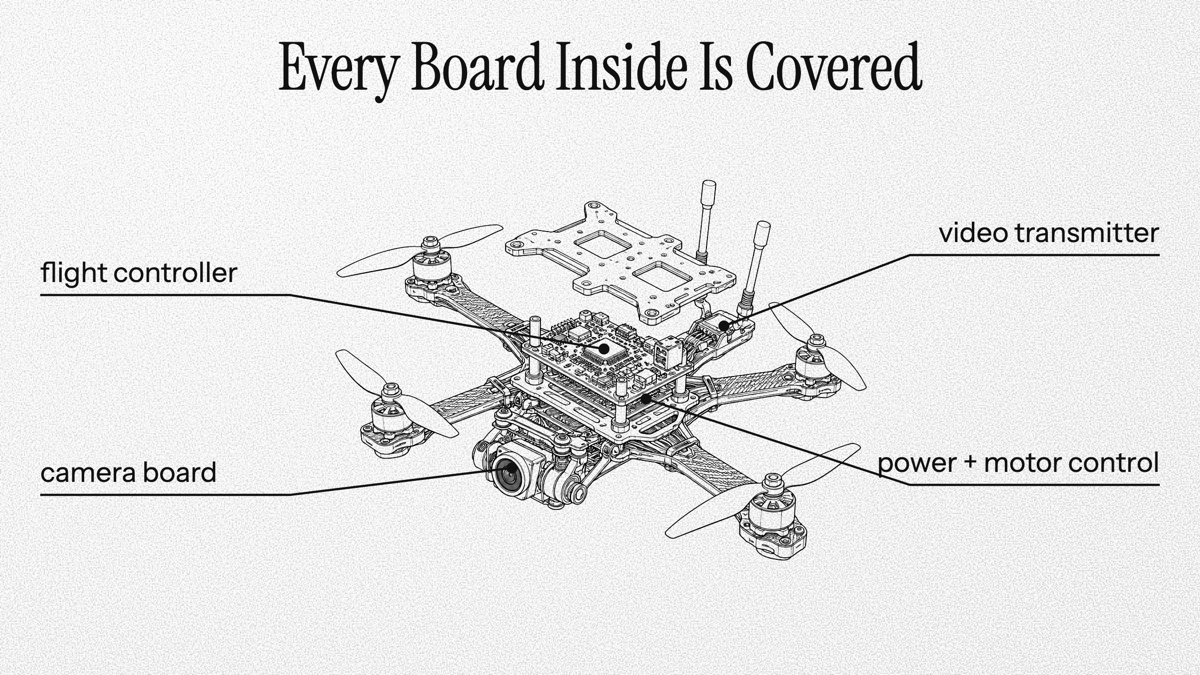
Every piece of modern defense hardware runs on circuit boards. Radios, drones, guidance systems, satellites, sensors. Every chip in those systems sits on a PCB, and the board is what connects everything together.
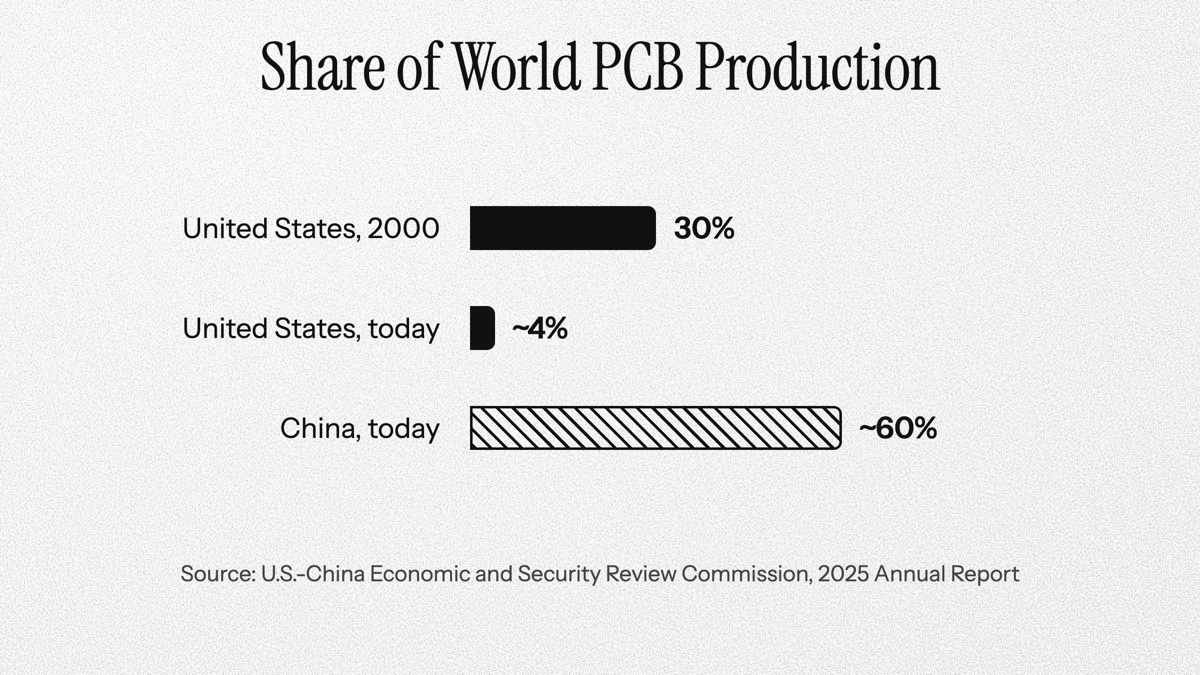
Over the last two decades, most of that manufacturing left the US. The United States made about 30% of the world's PCBs in 2000. Today it is closer to 4%, while China makes around 60%.
That is a problem for two reasons.
The first is trust. A board fabricated in an adversary nation passes through facilities the DoD cannot see into. The law names the risks directly: counterfeiting, quality, and unauthorized access. A board is a physical object, and once it leaves your hands, it is hard to fully verify what was done to it.
The second is dependence. If a conflict or trade dispute cut off access to Chinese fabs, a large share of the defense supply chain would stall. You cannot build a weapons system if you cannot get the boards that go inside it.
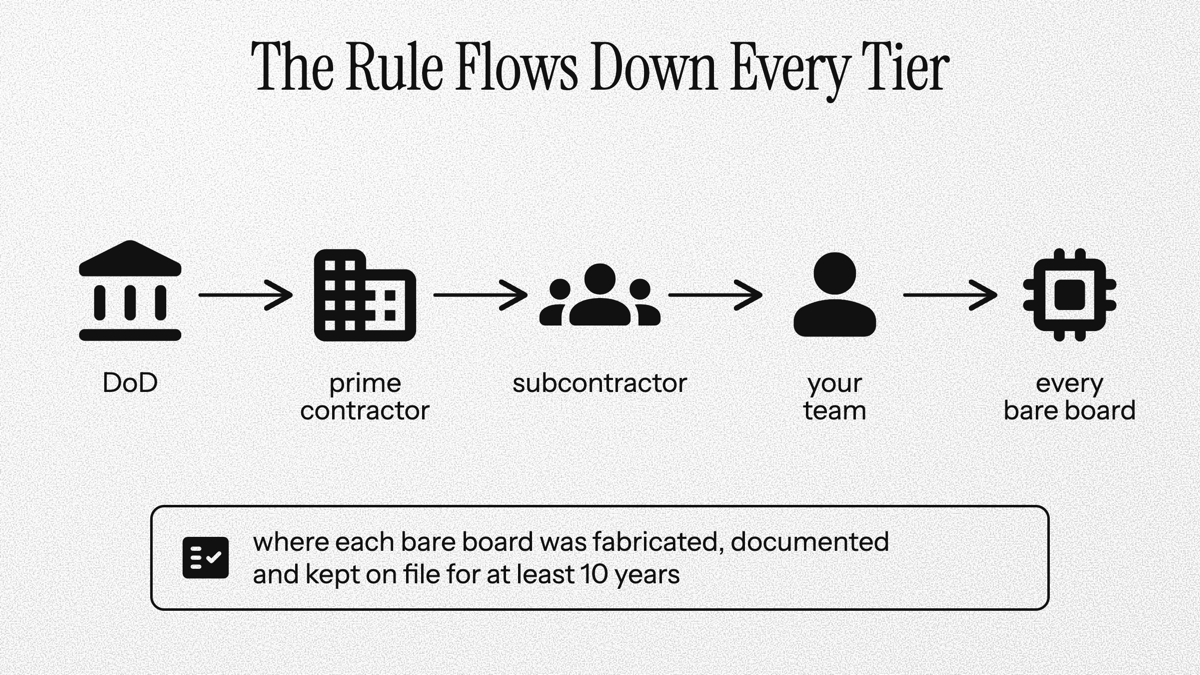
Congress passed the ban in the FY2021 NDAA and set the January 1, 2027 date in the FY2022 NDAA. In July 2026, the DoD published an advance notice describing how it plans to enforce it. Compliance would mostly come down to where the bare board was fabricated, the requirement would flow down to subcontractors at every tier, and suppliers would keep traceability records for at least 10 years after delivery. The notice also states a strong preference for facilities that design, fabricate, and assemble boards.
The final rule is not out yet, and the ban only applies to contracts signed after it is. But the direction is clear, and the date is set.
The Problem This Creates
The intent makes sense. The transition is going to be painful.
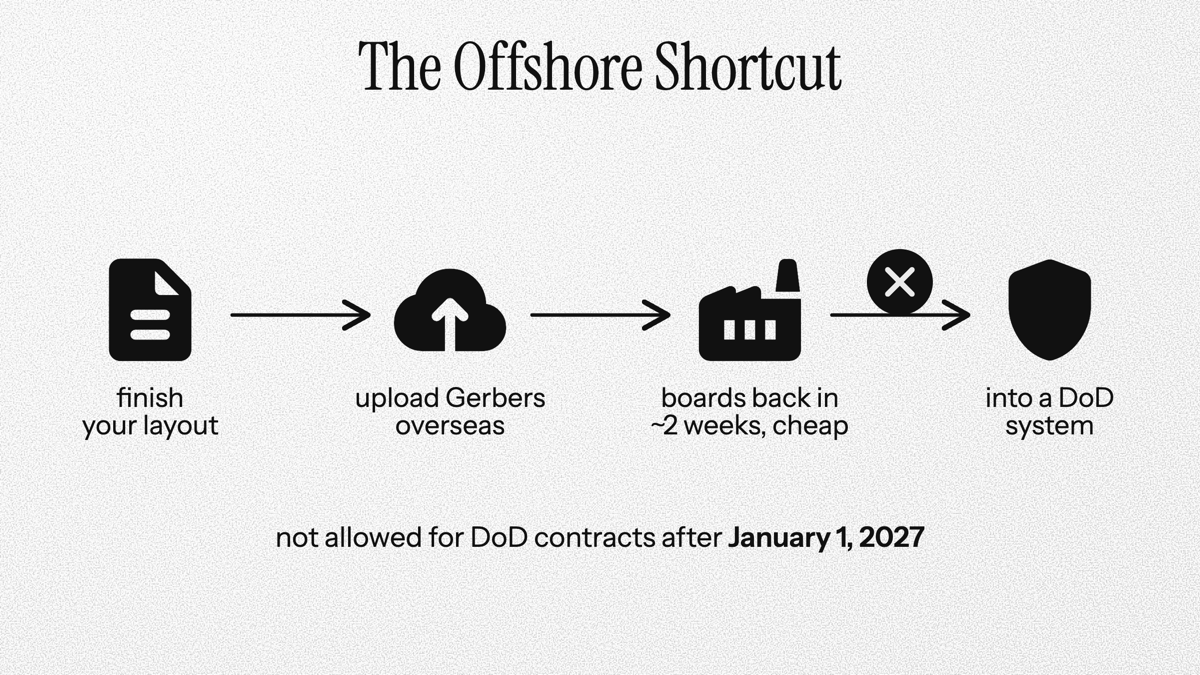
For years, the standard hardware workflow has been simple. You finish your layout, upload your Gerbers, and boards show up from overseas two weeks later at a low price. A lot of defense startups prototype this way because it is one of the fastest and cheapest options available.
That path is closing for anything headed into a DoD program, and the alternative is limited. With only about 4% of global capacity in the US, there are not many domestic fabs to absorb the new demand. As primes, subcontractors, and startups all move their boards at once, those fabs will get busier, and lead times and prices will go up.
Switching fabs is also not as simple as sending a new purchase order. A new supplier means new first articles, requalification, and new paperwork. Because the requirement flows down every tier, a small team building one subassembly for a larger system is on the hook too. They will need to know, and document, where every bare board in their product was made.
The teams that feel this most are the ones moving fastest. A defense startup trying to get a prototype in front of a customer next month cannot wait months for a domestic board, and it cannot risk a contract on an offshore one.
Our Approach
Right now, our process takes about four weeks from design to delivery. The US average is closer to four months.
We design boards and assemble them in San Francisco. Now we are building out our own facilities to bring bare PCB fabrication in house too, so every step happens in the US. Our first test run produced 0.1 mm traces. With fab in house, we can get our timeline down to three or even two weeks from design to delivery.
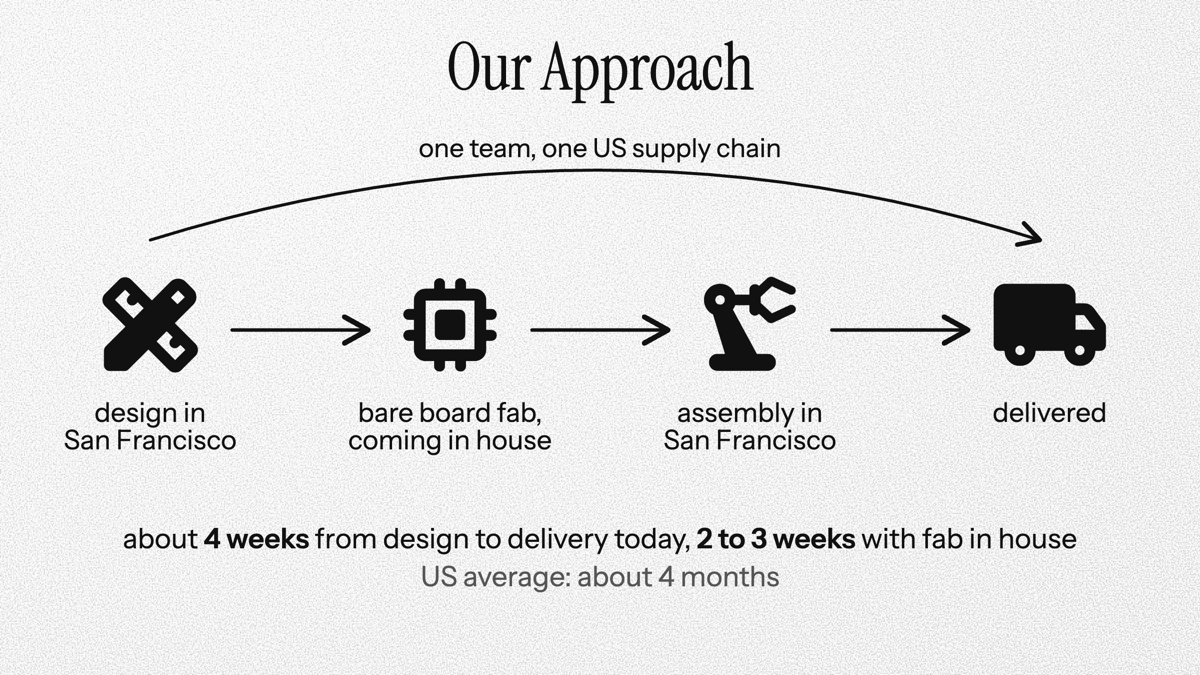
Keeping every step in one place solves several problems at once. There is one supply chain to trace instead of three. There is no waiting in a queue behind larger orders at someone else's fab. And when something needs to change, the people who designed the board are the same people building it, so a fix does not mean starting over with a new vendor.
Speed is still the point. We rebuilt a drone radio board in about a month after another firm had spent six months and four revisions on it. It worked first try and came out 30% smaller. We designed a 32-channel EEG board in three days, and an 8-layer software defined radio that is 67% smaller with the same RF performance. We want defense teams to get that speed without giving up a domestic supply chain.
What You Should Do Now
If you are building hardware that could end up in a DoD system, start now:
- Map where every bare board in your product is fabricated and assembled, including boards inside subassemblies from your suppliers.
- Get fabrication origin in writing from each supplier, and keep the records.
- Start moving at-risk boards early. Requalifying with a new fab takes longer than placing an order.
If you are building defense hardware and need boards made in the US, book a call.
Sources
More from the workbench.
All articles